How does the destruction of airway submucosal glands (SMGs) contribute to lung allograft fibrosis?
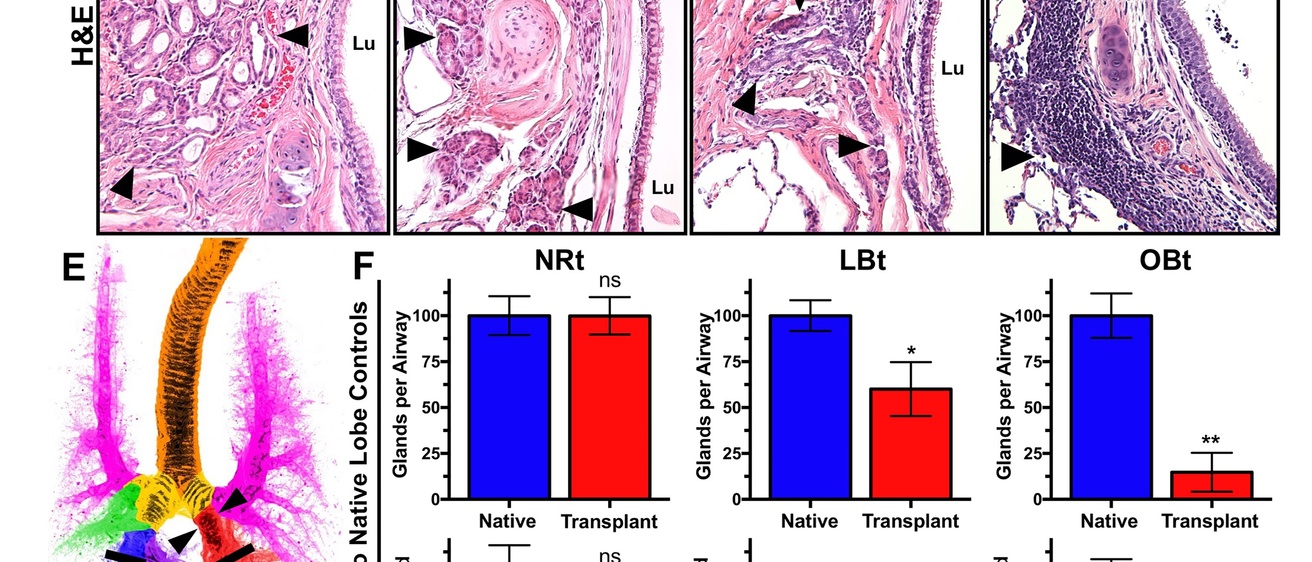
Ferret and human lung allografts. (A, B) SMGs (arrowheads) are present in native/healthy ferret airways (A), but are destroyed in transplanted ferret lobes that develop obliterative bronchiolitis (OB) (B). The number of well-defined glands per airway (C) and the number of tubuloacinar structures per gland (D) decreases in ferret allografts with OB. (E, F) The same is true for human pulmonary tissues. SMG are intact in control human pulmonary tissue (E), but they are destroyed in human pulmonary allografts with OB (F). The number of well-defined glands per airway (G) and the number of tubuloacinar structures per gland (H) decreases in human allografts with OB. Data are presented as the mean ± SEM. **p<0.01 by Mann-Whitney U-test.
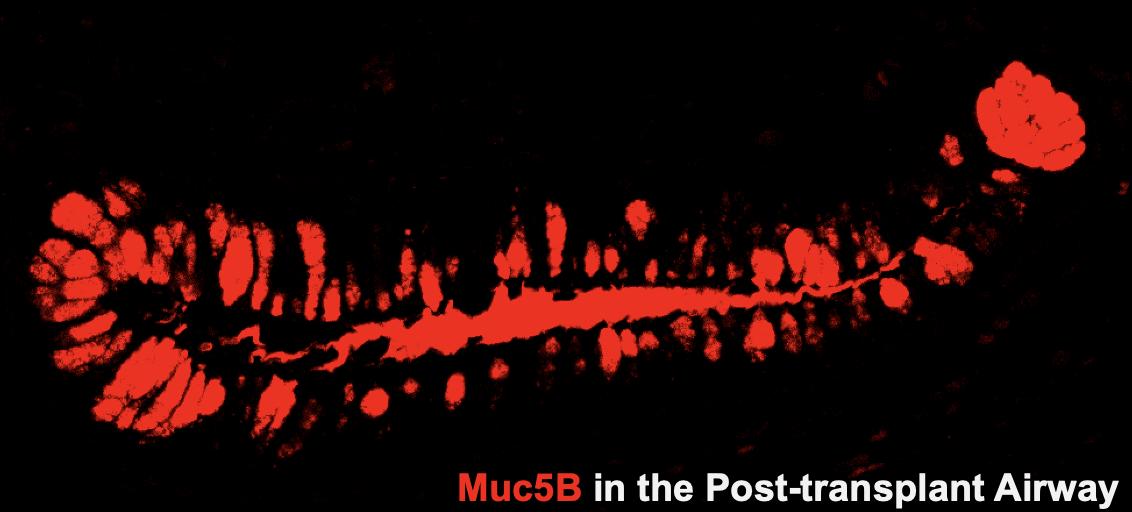
mucociliary clearance within the allograft.
Post-transplant airways exhibit marked MUC5B upregulation. Representative immunofluorescent image demonstrating enhanced MUC5B protein expression in the airway epithelium of post-transplant lung tissue of humans compared to controls. This robust overproduction of gel-forming mucin reflects ongoing epithelial stress, secretory cell hyperplasia, and altered mucociliary clearance within the allograft.